Your Phone (and Inbox) Tells You: Real-Time Operating Alerts
May 3, 2026 · Steve Berry, N1EZ
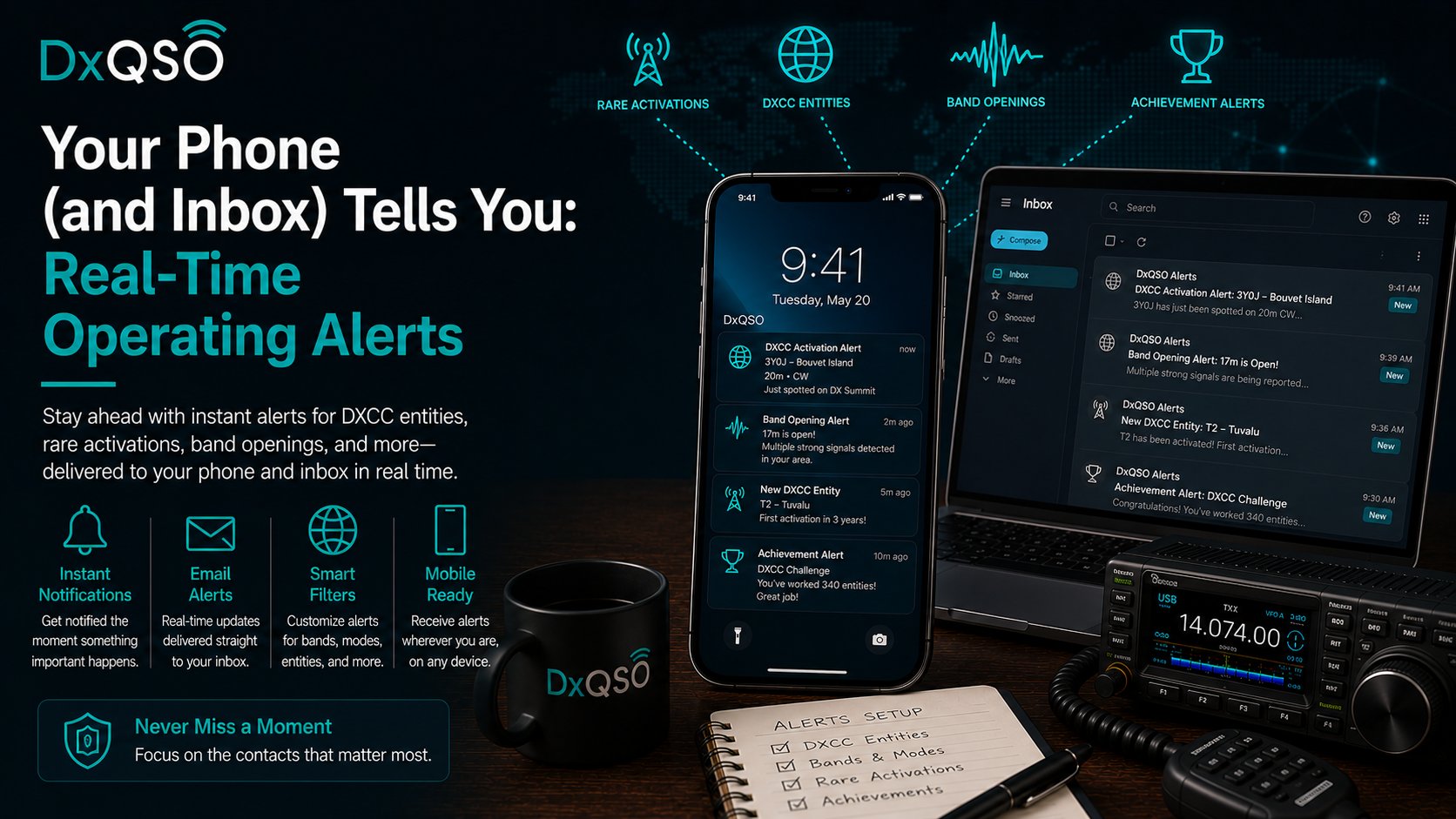
If I had to put the entire idea of DxQSO on a bumper sticker, it would be this: the hobby should pay attention to you, instead of you doing all the checking. Today that idea graduates from a handful of specific notifications into a real, general framework for real-time operating alerts — delivered to the phone in your pocket and the email in your inbox. This is the feature the whole system has been pointing toward.
From “go check” to “it comes to you”
For years, staying on top of this hobby meant a loop of manual checking. Refresh the cluster. Log in to LoTW®. Look at QRZ.com. See if that confirmation came through. Notice the band opened an hour after it mattered. Every one of those checks is the system failing to tell you something it already knew. It is exactly the friction DxQSO was built to remove.
Real-time operating alerts flip it around. DxQSO already holds your one living record — what you have worked and what you are chasing — plus the preferences you set for how you operate. It is already capturing your activity live through the Network Listener and receiving your confirmations from LoTW and QRZ as they land. The alerts framework turns all of that into timely, personal messages, delivered to whichever channel suits you — a push to your phone, a note in your inbox, or both.
Targeted to how you operate
A generic firehose of notifications is just noise, so these are built to be personal. A DX chaser, a POTA activator or hunter, a contester, an FT8 grid hunter, a club member, an award chaser — each cares about different things at different moments. The alerts framework is designed to know the difference, so what reaches you is relevant to the operator you actually are, not a one-size-fits-all blast.
The moment a confirmation crosses an award line. A friend in your club lighting up a rare one. Your team’s activity during a contest. Something happening on the air that fits how you operate. These are the things worth a buzz in your pocket or a line in your inbox — and they are exactly the things you used to have to go hunting for, evening after evening.
Push, email, or both — and only what you want
Control is the difference between an alert system you keep on and one you mute in a week, so the framework is built around your preferences. Every type of notification can be turned on or off independently, and for each you choose the channel: a push to your phone for the things you want to know the instant they happen, an email for the things you would rather review later, or both. You tell DxQSO a little about how you operate — what you chase, what you care about — and it uses that to decide what actually deserves to reach you. The goal is a system you trust enough to leave running, because when it does buzz, it is right.
The hard part is knowing what not to send
Anyone can send more notifications. The engineering that matters is restraint — surfacing the confirmation that crosses an award line while staying silent about the hundred routine ones that do not. A firehose trains you to ignore it, and an ignored alert is worse than no alert, because the one that mattered goes unnoticed too. So the framework is designed to be quiet by default and loud only when it should be. That is a harder problem than it sounds, and getting it right is exactly why we built a real framework instead of bolting on one more notification at a time.
The framework, not just the features
What ships today is a foundation: a flexible alerts engine the rest of DxQSO can build on. The QSL alerts and achievement notifications you already know are early examples of it. What makes this a milestone is that alerting is now a general capability — a way for DxQSO to surface anything timely and personal, which means it only gets smarter and more useful from here.
And it sets up the most exciting direction of all. Right now the alerts are driven by your own activity and confirmations. The next step is to combine that with what is happening on the bands in general — so DxQSO can tell you not just what you did, but what you should do next, given how you operate. I will have a lot more to say about that soon. For now, make sure notifications are on, tell DxQSO a little about how you operate, and go live your life. When something is genuinely worth your attention, you will hear about it.