Capture Every Contact Automatically: the Network Listener
Sep 19, 2025 · Steve Berry, N1EZ
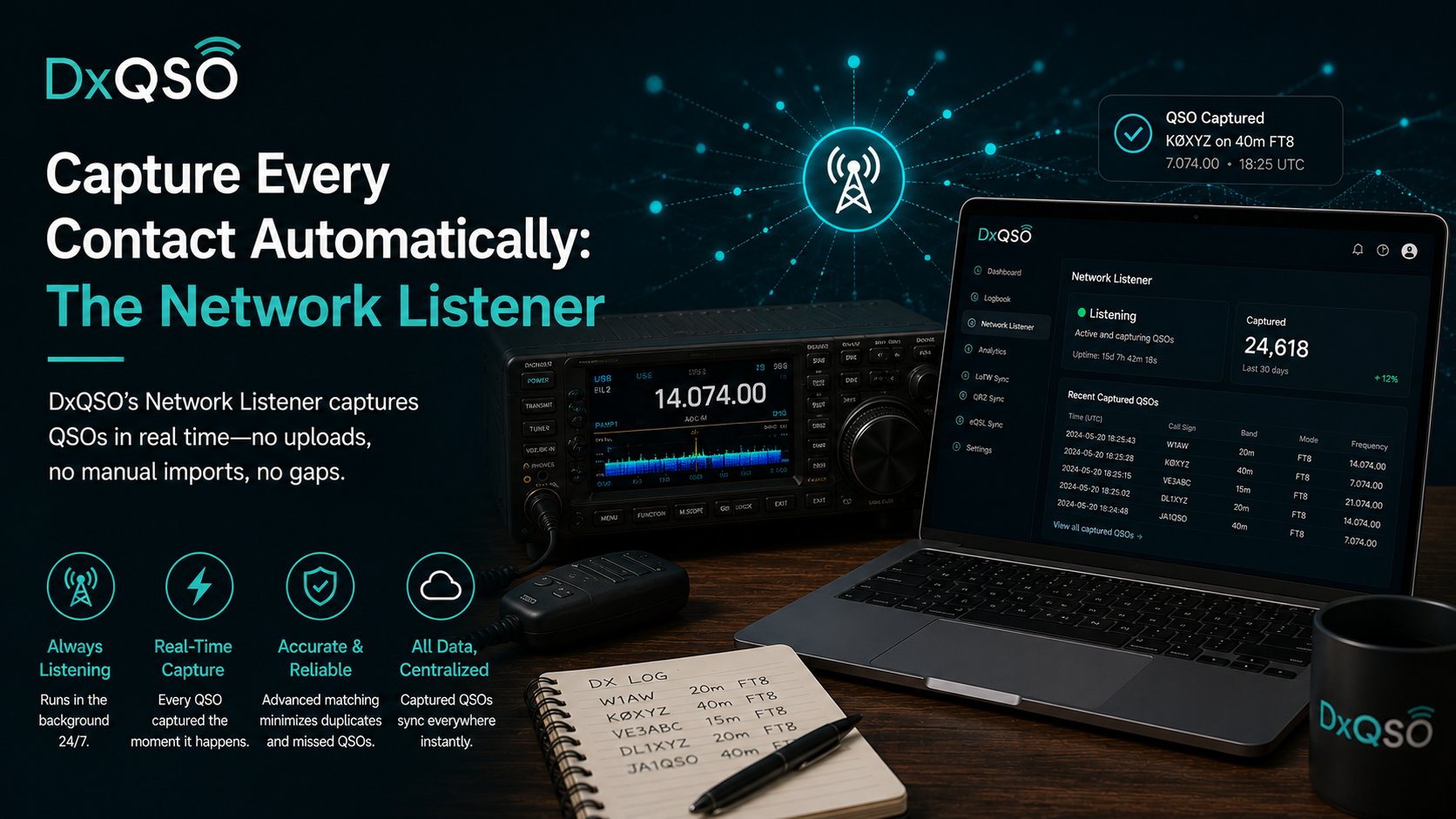
The best log entry is the one you never have to make. That idea sits at the heart of one of my favorite parts of DxQSO, and it is now available to everyone: the Network Listener, which captures your contacts automatically as you make them — from the logging software you already use — with no exports and no end-of-session ritual.
How it works
Many of the programs we operate with already broadcast each contact over your local network the instant you log it, using the widely supported N1MM UDP format. The DxQSO Network Listener simply listens for those broadcasts and folds each contact into your one living record in real time. You operate in your favorite software; your DxQSO record fills itself.
Because it speaks that common UDP language, it is not tied to a single program, and that is very much on purpose. N1MM Logger+ during a contest, SmartSDR or SDR Control from an iPad, and the excellent remote and SDR apps from Marcus Roskosch all work with it. If your software can send N1MM-style UDP, DxQSO can capture from it. We did not build a one-app integration — we built a listener for an entire ecosystem of the tools hams already love.
This is connectivity, made literal
I talk a lot about DxQSO being a system that adds connectivity rather than another logbook. The Network Listener is that sentence turned into a feature. It does not ask you to log anywhere new. It quietly connects the software in front of you to your live cloud record, and from there to everything else DxQSO does. The moment a contact is captured, it can drive a confirmation alert, update an achievement, or show up in your club’s shared activity — all in real time, because the contact arrived in real time.
What it changes
For contesters, this is the difference between operating and bookkeeping. You run the rate meter in your contest logger and stay in the chair; every contact streams into DxQSO as it happens, and the whole weekend is in your cloud record without a single manual export when the dust settles. Your teammates can even watch the effort add up live.
For portable and remote operators, it means contacts captured live from the field, or from a remote station you are running on a tablet across the country. And because everything lands the instant it happens, the rest of DxQSO — the alerts, the achievements, the sharing with people you operate with — can act on your operating as it unfolds, not hours later at home.
Why capture beats export, every time
An export is a thing you have to remember to do, at the end, when you are tired and the interesting part is over. It is the single most common way a session gets lost — the log that never made it out of the contest software, the activation that stayed trapped on a laptop until the details had faded. Live capture removes the failure point entirely. There is no end-of-session step to forget, because there is no end-of-session step at all. Each contact is already safe in your cloud record the instant you log it, which means it is also already eligible to trigger an alert, move an achievement, or show up to your club — none of which can happen to a contact still sitting in an unexported file.
That is the quiet superpower here. Real-time everything in DxQSO depends on the contact arriving in real time, and the Network Listener is how that becomes true for the software you already run. It turns your existing logging program into a live feed without asking it to be anything other than what it already is.
Digital modes get it for free
If you run FT8 or FT4, this matters more than it might first appear. GridTracker — which so many digital operators already keep open alongside WSJT-X — can broadcast your contacts in the same N1MM UDP format, which means the Network Listener captures your FT8 and FT4 QSOs live, as you work them, with nothing new to learn. Those are exactly the contacts that pile up fastest and are easiest to leave sitting in a file, so having them stream straight into your record — and into your grid and DXCC achievements — is a real quality-of-life change for the digital crowd.
Set it once
You turn the Network Listener on, point your logging software at it the way you already point it at anything else on your network, and forget it exists. That is the highest compliment I can pay a feature: it disappears, and your contacts simply show up — live, in the system that turns them into alerts, achievements, and shared moments with your friends. If you have ever lost a session because you forgot to export, this one is for you.