Upload POTA Contacts to LoTW and QRZ From Your Phone
May 13, 2025 · Steve Berry, N1EZ
Let me start with what DxQSO is not, because it explains everything else. DxQSO is not another logbook. The hobby already has plenty of excellent logging programs, and I have no interest in asking you to abandon the one you love. DxQSO is the connected system that sits underneath the logbooks you already use — holding your contacts in one place and adding the connectivity the desktop era never gave us. Today’s feature is a perfect example of that idea, and it is aimed squarely at the operators who live in the field.
The ritual I wanted to delete
If you activate parks, you know the routine. You get home, sit down at the computer, export an ADIF, sign it, and push it to Logbook of The World® (LoTW®) — often days after the activation, once the fun has worn off and the to-do list has grown. None of that is operating. All of it is friction between you and the confirmations you earned. I wanted to remove it entirely.
Think about how many steps sit between a great afternoon in the park and the confirmations that afternoon actually earned you. You unpack the radio, find the laptop, remember which folder the log ended up in, export the ADIF, open TQSL, pick the right station location, sign, submit, and then do a version of the same dance again for QRZ. Every one of those steps is a place to forget, to make a mistake, or to simply run out of evening. Multiply it across a summer of activations and the backlog becomes the reason a lot of good operators quietly stop chasing awards at all. The contacts were never the hard part. The paperwork was.
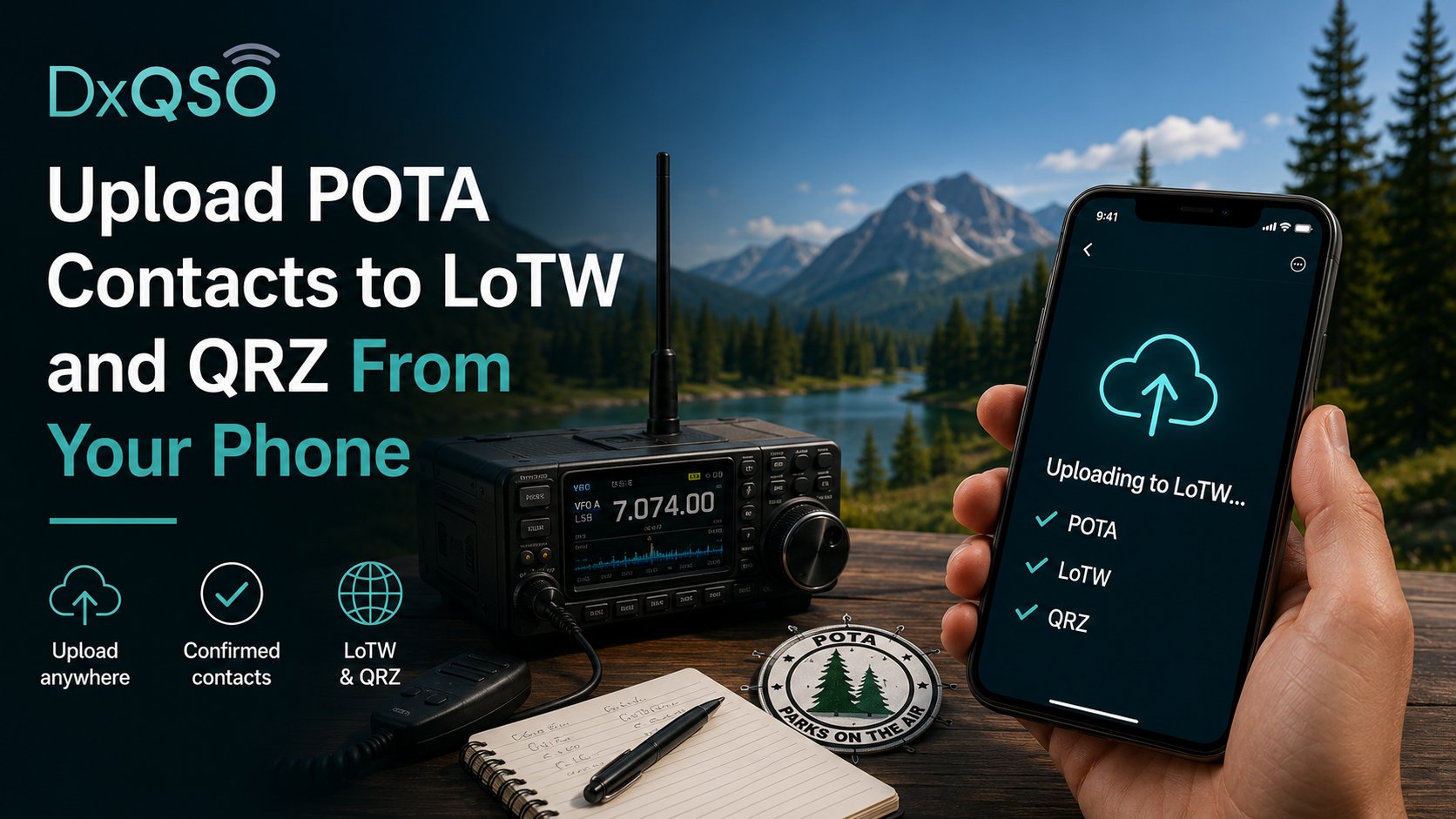
Starting today, DxQSO can submit your contacts to LoTW and QRZ for you, automatically, from our servers. You log your activation in whatever app you already use in the field — a POTA app, a portable logger, whatever fits your kit. DxQSO pulls those contacts into your one living record, and, if you turn the feature on, hands them off to LoTW and QRZ on your behalf. By the time you have packed the antenna and started the drive home, your contacts are already on their way to becoming confirmed QSLs.
How it actually works from the field
The mechanics matter, so here is the honest version. When you finish an activation, you get your contacts into DxQSO the same way you always upload — an ADIF straight from your phone or tablet, or a live feed if you are running a logger that supports it. From there the submission to LoTW and QRZ happens on our servers, on a schedule you control, without your laptop needing to be open or even in the same state as you. There is nothing to sign at the kitchen table, because the signing and the handoff happen in the cloud.
Two details make this safe to leave running. First, it is duplicate-aware: upload the same log twice, or overlap a field export with a later full export, and DxQSO reconciles it instead of double-submitting. You never have to remember whether a batch already went out. Second, everything is tied to your station locations and preferences, so a POTA activation from a portable setup and a contact from the home shack each go out correctly attributed. You set it up once; after that the field-to-LoTW path is just automatic.
Connectivity, not a replacement
Notice what did not change: the program you used to make the contacts. That is the whole philosophy. You keep your logbook; DxQSO adds the bridge between it and the wider world — LoTW, QRZ.com, and the phone in your pocket. Server-side submission to LoTW and QRZ is the first big piece of that promise made real for POTA and SOTA activators, because it means getting your contacts to LoTW and QRZ no longer depends on you being at a particular computer with a particular piece of software open. The work happens in the cloud, wherever you are.
This is a Member feature, and it is a deliberate one. It is also the start of a thread you will see running through everything we build: DxQSO is a system that connects your existing operating to the tools and people that make the hobby rewarding, and then delivers the results back to you without you having to go looking.
It works whether or not you live on LoTW
Not everyone who activates is deep into LoTW, and that is fine. If you do use it, this closes the loop automatically. If you do not, the same pipeline still carries your contacts into QRZ and into your one living record, so the log you made in the field is consolidated, backed up, and searchable everywhere without any manual import. The point is not to push you toward any one service — it is to make sure the contacts you worked land wherever you want them to land, on their own.
For the hunters, too
Activators feel this first, but hunters are the other half of the equation. Every activation that reaches LoTW and QRZ faster is a confirmation reaching a hunter faster — the person who chased you to a new park, a new state, or a new grid gets their credit sooner, without either of you doing extra work. The whole park-to-park economy runs on confirmations actually showing up, and the less they depend on someone remembering to do the paperwork days later, the better the hobby works for everyone in the chain.
Activate, upload, go home knowing
I have been chasing and activating long enough to remember when “getting your contacts to LoTW” was an evening project, a chore that stood between the operating and the satisfaction. It should be a non-event. You did the work in the field; the paperwork should follow you home on its own, quietly, while you are thinking about the next trip.
If you spend your weekends in the parks, turn this on and pay attention to how the drive home feels when you already know your QSLs are landing. Then tell me about it. The portable crowd has shaped DxQSO more than any other group of operators, and this feature exists because you asked for exactly this kind of connectivity. There is a great deal more coming — but freeing your field contacts from the kitchen-table ritual felt like the right place to begin.