Faster, Real-Time Sync: Why We Rebuilt the Data Engine
Jul 16, 2025 · Steve Berry, N1EZ
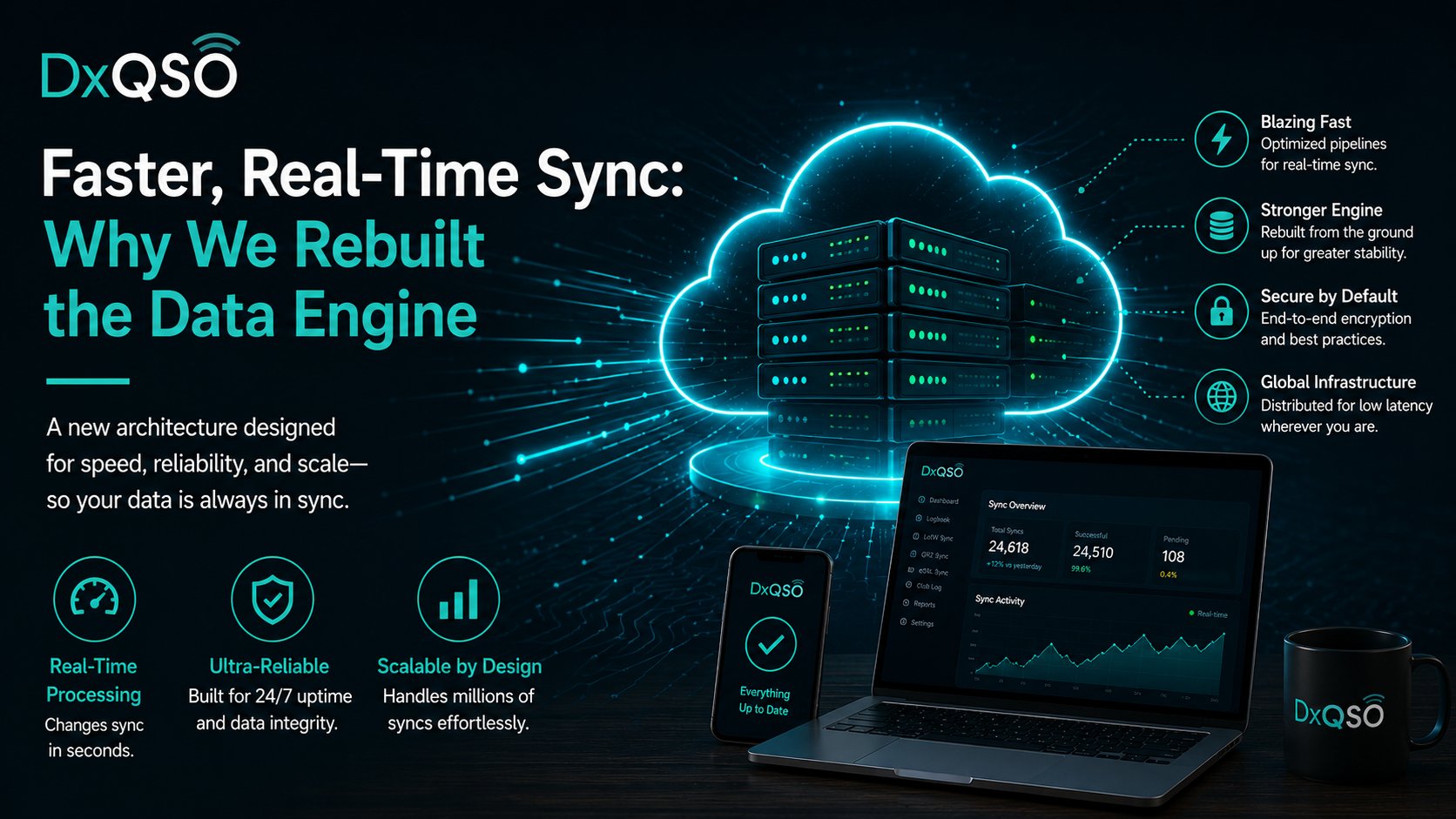
This post is about plumbing, and I am not going to apologize for it. The least glamorous work we do — the engine that keeps your contacts in sync — is the work that makes everything else in DxQSO possible. If that engine is slow or unreliable, then the alerts, the achievements, and the collaboration we are building on top of it are slow and unreliable too. So we went back and rebuilt it.
Why real-time is the whole point
Remember what DxQSO actually is: not a logbook, but a system that connects the logbooks you already use to the phone in your pocket and the email in your inbox. That only works if your operating record is genuinely live. A confirmation that lands on LoTW® is worthless as an alert if it takes hours to reach you. A new grid you just worked cannot show up in your achievements, or in your club’s shared activity, if the record is stale. Real-time is not a nice-to-have here. It is the product.
Early on, as logbooks grew into the tens of thousands of contacts, our original sync path started to creak. Opening your record on a phone over a marginal connection at a park is a very different problem than opening it on a fast desktop at home, and the first engine was not built for that world. So we rewrote how DxQSO fetches, caches, and updates your contacts from the ground up.
What changed under the hood
Three things, in plain terms. First, syncing is now incremental — the system asks for what has changed since it last checked, instead of hauling your whole record every time. Second, the data each device holds is smarter, so reviewing and searching your contacts no longer waits on the network. Third, we tightened the timestamps and bookkeeping that decide what is actually new — the unglamorous detail that makes “what changed since last time” trustworthy enough to trigger an alert you can rely on.
None of that shows up as a button. It shows up as the system feeling immediate, and as confirmations and activity reaching you in something close to real time instead of whenever the app got around to noticing.
Built for the marginal connection, not the lab
The place a sync engine actually gets tested is not a fast desktop on home fiber. It is a phone with two bars at the far end of a park road, on a battery you are trying to conserve, when you just want to confirm the log made it up before you tear down. That is the environment we optimized for. Incremental sync means a check-in over a weak signal moves a few kilobytes, not your entire operating history. Smarter on-device data means the record you already pulled is right there to scroll and search even if the connection drops entirely.
The same design pays off at home, too. When your record lives across tens of thousands of contacts, the difference between “ask for what changed” and “pull everything, again” is the difference between a logbook that opens instantly and one you learn to dread opening. The engine now behaves the same way on a huge record as it does on a small one, which is the only way a tool stays usable as your operating grows over years.
Reliable enough to build alerts on
Speed was only half the job. An alert framework is only as trustworthy as the timestamps underneath it. If the system cannot say with confidence what is genuinely new, it either misses confirmations or cries wolf — and both erode your trust fast. A missed new-DXCC alert is a disappointment; a stream of false ones is worse, because you learn to ignore the buzz, and then the one that mattered slips by too. Tightening that bookkeeping is invisible work, but it is the entire foundation of a notification you will actually act on.
That is why we treated “what changed since last time” as a first-class problem rather than an afterthought. Every confirmation, every new grid, every award milestone that DxQSO can promise to tell you about depends on the system knowing, precisely, that it is new. Get that right and the alerts feel like magic. Get it wrong and the whole idea falls apart.
The foundation for everything next
I am telling you about a rebuild most companies would never mention because it is the quiet enabler behind the features I am most excited to ship over the coming year. Automatic capture from the field and the shack. Instant QSL alerts to your phone and inbox. Achievements that update the moment a confirmation lands. Clubs and teams seeing each other’s activity live. Every one of those depends on a sync engine fast and reliable enough to keep up with how you actually operate.
You will not see a changelog entry that says “we rewrote the data engine.” You will just notice that your record is current when you want it, that alerts arrive when they should, and that the system stays out of your way. That was the entire point — building the real-time foundation that the rest of DxQSO stands on.